Background
Staphylococcus aureus (SA) and Pseudomonas aeruginosa (PA) are two common pathogenic bacteria. Staphylococcus aureus can cause various infections, including skin infections, food poisoning, and more severe systemic infections, while Pseudomonas aeruginosa frequently causes respiratory tract infections, wound infections, urinary tract infections, and sepsis in immunocompromised patients. Pseudomonas aeruginosa's high resistance to antibiotics renders treating infections more complex and challenging. This study aims to investigate the effects of 2′-fucosyllactose (2′-FL) on the growth of both pathogens and its influence on phagocytosis by polymorphonuclear neutrophils (PMNs), a crucial type of immune cell.
Research Design and Methods
In this study, PMNs were isolated from the peripheral blood of healthy volunteers and incubated with 2′-FL (0.5–2.5%) before co-incubation with green fluorescent protein (GFP)-labelled SA or PA for 60 hours. Bacterial growth was assessed by measuring GFP relative fluorescence units (GFP-RFU), and the inhibitory effect of 2′-FL on bacterial growth was evaluated by calculating the lag phase duration. Concurrently, the number of viable bacterial colonies was observed to evaluate growth status.
Key Findings
1. Effects of 2′-FL on SA and PA Growth
At certain concentrations, 2′-FL significantly inhibited the lag phase duration of SA and PA. Notably, high concentrations of 2′-FL (2.5%) markedly reduced the lag phase duration of both SA and PA (P<0.05). 2′-FL extended the lag phase duration of SA and PA by approximately 2 hours and 1.5 hours respectively, indicating that 2′-FL effectively suppresses the early growth stages of these pathogens.
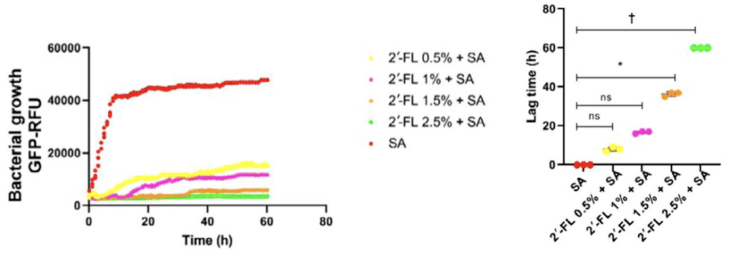
Figure 1: Effect of 2′-FL on SA growth
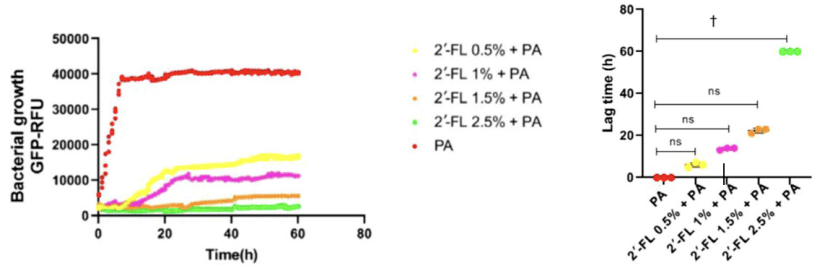
Figure 2: Effect of 2′-FL on PA growth
2. Effect of 2′-FL on CFU Counts of Two Pathogenic Bacteria
2′-FL demonstrated significant efficacy in reducing CFU counts of both pathogenic bacteria. Compared to the control group, the 2′-FL-treated groups exhibited markedly reduced CFU counts for both SA and PA, indicating that 2′-FL not only delays bacterial growth but also diminishes their active reproductive capacity. Specifically, a 2.5% concentration of 2′-FL reduced the CFU count of SA by approximately 60% and that of PA by approximately 50%.
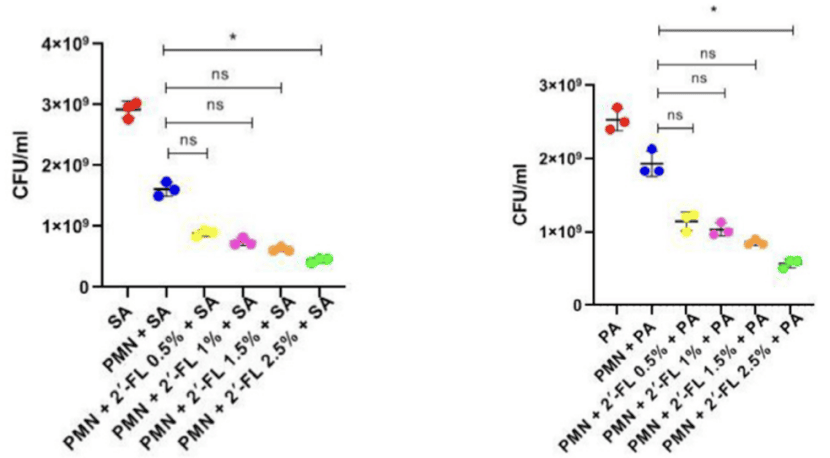
Figure 3: CFU after 60 hours of incubation with bacteria, PMNs and 2′-FL
3. Enhancement of PMN Phagocytic Capacity by 2′-FL
In the presence of PMNs, 2′-FL further enhanced the phagocytic capacity of PMNs towards bacteria. Experiments demonstrated that 2′-FL-treated PMNs exhibited significantly increased phagocytic activity towards SA and PA. This enhancing effect may be attributable to 2′-FL's capacity to stimulate PMN activation, thereby increasing their recognition and phagocytic efficiency towards pathogens.
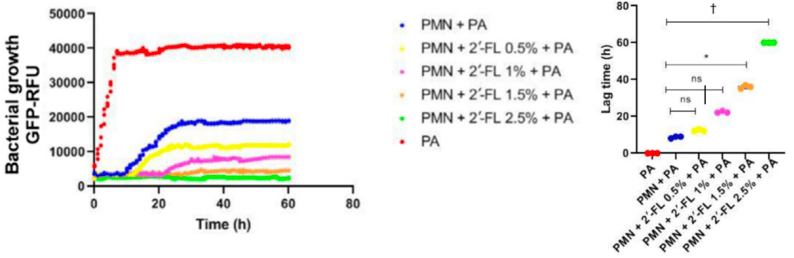
Figure 4: Effect of 2′-FL on the phagocytosis of bacterial GFP-SA by PMNs
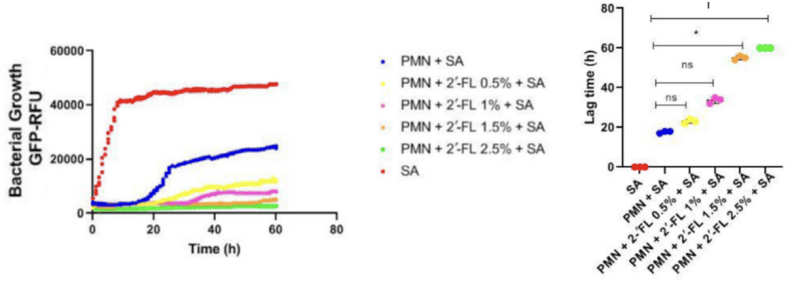
Figure 5: Effect of 2′-FL on the phagocytosis of bacterial GFP-PA by PMNs
Discussion and Outlook
Research indicates that 2′-FL can inhibit the growth of pathogenic bacteria SA and PA while enhancing the phagocytic capacity of PMNs, a crucial type of immune cell. These findings provide a foundation for further investigationthe application of human milk oligosaccharides in preventing and treating bacterial infections. Moreover, human milk oligosaccharides may hold potential clinical value in enhancing immune function and preventing pathogen infection. Future research should further investigate its role and mechanisms across different infection models to validate the feasibility and efficacy of its clinical application.
Reference
[1] Mortaz, E., Nomani, M., Adcock, I., Folkerts, G., & Garssen, J. (2022). Galactooligosaccharides and 2′-Fucosyllactose can directly suppress growth of specific pathogenic microbes and affect phagocytosis of neutrophils. Nutrition, 96, 111601. https://doi.org/10.1016/j.nut.2022.111601