Background
2′-Fucosyllactose (2′-FL) is a key component of human milk oligosaccharides (HMOs), which have garnered significant attention in recent years for their role in enhancing infant immunity and maintaining gut health. Research indicates that 2′-FL not only confers significant benefits for gut health but also modulates immune responses during respiratory viral infections. Notably, 2′-FL exhibits pronounced antiviral effects in regulating immunity against respiratory syncytial virus (RSV). RSV is a primary pathogen causing severe respiratory infections in infants and young children, who are particularly vulnerable due to their immature immune systems. Consequently, investigating the immune-enhancing effects of 2′-FL against RSV holds significant clinical application potential. This paper will focus on discussing the immunomodulatory role of 2′-FL in RSV infection and its potential applications.
Research Design and Methods
This study explored the effects of 2′-FL on RSV infection through in vitro experiments. Research was conducted using 16HBE human bronchial epithelial cells and a polarised Calu-3 epithelial cell model. Following RSV infection of the cells, varying concentrations of 2′-FL were added to assess its impact on viral replication and inflammatory cytokine expression. Secretion levels of pro-inflammatory factors (including IL-6, IL-8, MIP-1α, and TNF-α) were measured via ELISA and qPCR, whilst viral load was evaluated through viral titration assays.
Key Findings
1. 2′-FL significantly reduces RSV viral load
Experimental results demonstrate that RSV viral load is markedly diminished in 16HBE cells treated with 2′-FL, particularly at concentrations exceeding 50 μg/mL. This finding indicates that 2′-FL inhibits RSV replication even at low concentrations, revealing its potent antiviral potential.
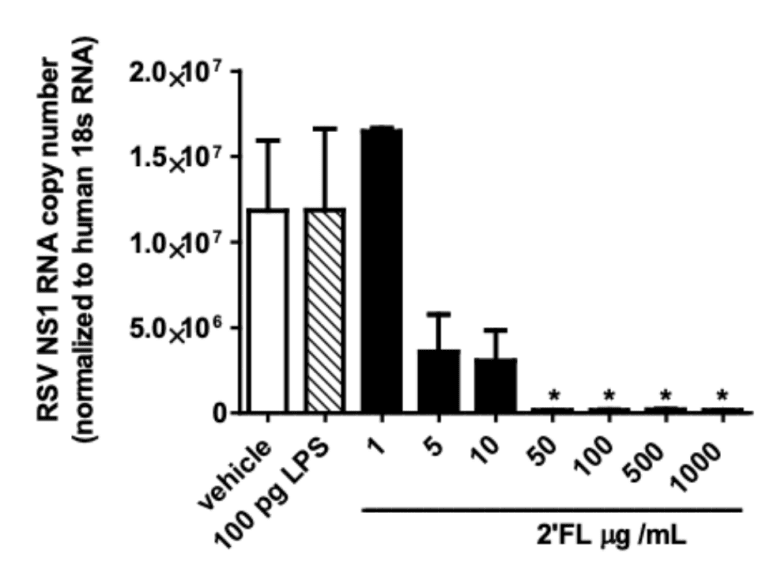
Figure 1: Analysis of the effect of 2′-FL on RSV NS1 gene expression in 16HBE epithelial cells via qRT-PCR. *p<0.05
2. 2′-FL Inhibits RSV-Associated Pro-inflammatory Factors
Studies indicate that in RSV-infected 16HBE cells, 2′-FL significantly reduced the secretion of pro-inflammatory factors such as IL-6, IL-8, MIP-1α, and TNF-α. This reduction in inflammatory mediators demonstrates that 2′-FL effectively suppresses excessive inflammatory responses triggered by viral infection, thereby mitigating virus-induced tissue damage.
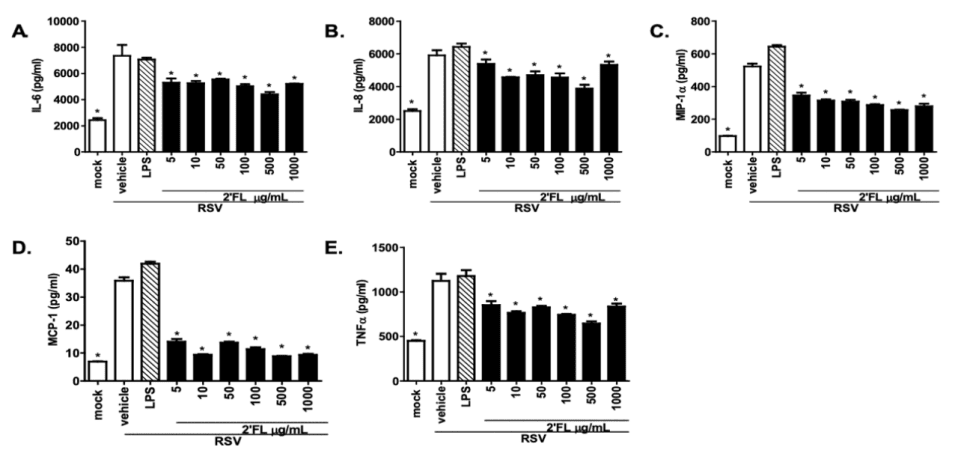
Figure 2: 2′-FL reduces inflammatory cytokine markers in 16HBE epithelial cells infected with RSV. *p<0.05, (A) IL-6; (B) IL-8; (C) MIP-1α; (D) MCP-1; (E) TNF-α.
3. Expression of 2′-FL in Calu-3 cells
Further studies confirmed that 2′-FL similarly reduced viral load in polarised Calu-3 epithelial cells, demonstrating effective anti-RSV activity and indicating its broad utility across diverse cellular models.
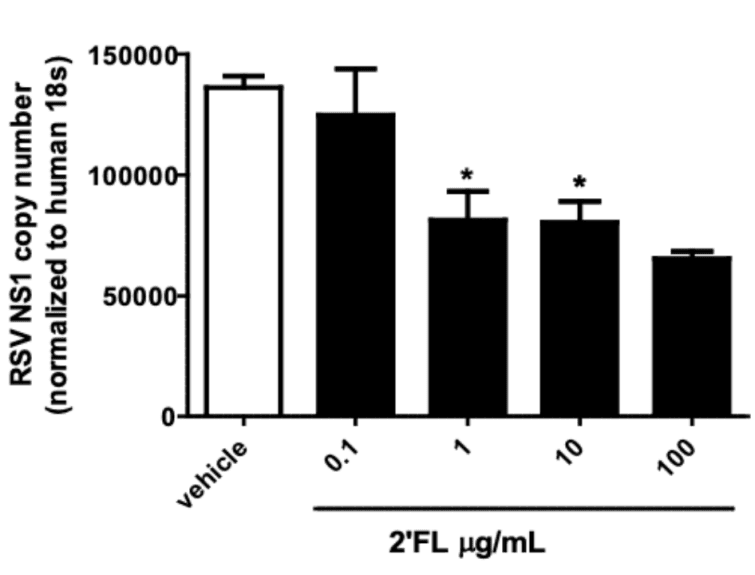
Figure 3: Effect of 2′-FL on RSV NS1 gene expression in Calu-3 epithelial cells. *p<0.05
Discussion and Outlook
This study has established the immune-enhancing role of 2′-FL in RSV infection. By reducing viral load and decreasing the secretion of inflammatory cytokines, 2′-FL demonstrates significant antiviral and anti-inflammatory effects. Its specific action in RSV infection provides a theoretical basis for the development of future antiviral therapies and prophylactic products, further confirming its potential as a health protection product for infants and young children. Future research may further explore the broad-spectrum efficacy of 2′-FL in other viral infections, particularly its potential application in respiratory health management for infants and young children. Moreover, as a natural antiviral and immune enhancer, 2′-FL holds promise for widespread use in infant nutritional supplementation and the prevention of respiratory diseases in adults, especially among populations with compromised immune systems.
Reference
[1] Duska-McEwen G, Senft A P, Ruetschilling T L, et al. Human milk oligosaccharides enhance innate immunity to respiratory syncytial virus and influenza in vitro[J]. Food and Nutrition Sciences, 2014, 2014.