
background
The early establishment of the gut microbiota is crucial for newborn health, playing a central role not only in immune system development but also in regulating metabolic functions. Studies have shown that human milk oligosaccharides (HMOs), particularly 2′-fucosylated lactose (2′-FL), significantly contribute to shaping beneficial gut microbiota and promoting the production of metabolites such as short-chain fatty acids. This study employed an in vitro human colon model (HCM) to simulate real intestinal environments, evaluating 2′-FLs regulatory effects on microbial abundance and metabolic balance. The findings provide scientific evidence supporting the functional applications of 2'-FL.
Research design and methods
This study employed an in vitro human colon model (HCM) to simulate the intestinal environment of infants and evaluate the regulatory effects of 2'-FL on gut microbiota abundance and metabolism. The HCM system was dividedthree regions: ascending colon, transverse colon, and descending colon, inoculated with eight representative infant intestinal bacteria to recreate a typical microecological system. By adding 2 grams of 2'-FL to the culture medium, real-time quantitative PCR (qPCR) was used to detect changes in microbial abundance, while liquid chromatography-mass spectrometry (LC/MS) was employed to measure the levels of metabolites such as short-chain fatty acids.
Key findings
1. 2'-FL optimizes bacterial abundance in infant gut microbiota
In the HCM model, 2'-FL significantly altered the abundance of representative microbial communities. PCR analysis revealed that beneficial bacteria such as Bacteroides distasonis increased markedly in the ascending, transverse, and descending colon, while harmful bacteria like Clostridium perfringens decreased. These results demonstrate that 2'-FL promotes the growth of beneficial bacteria and inhibits the proliferation of harmful bacteria, thereby contributing to the establishment of a healthy intestinal microecological environment.
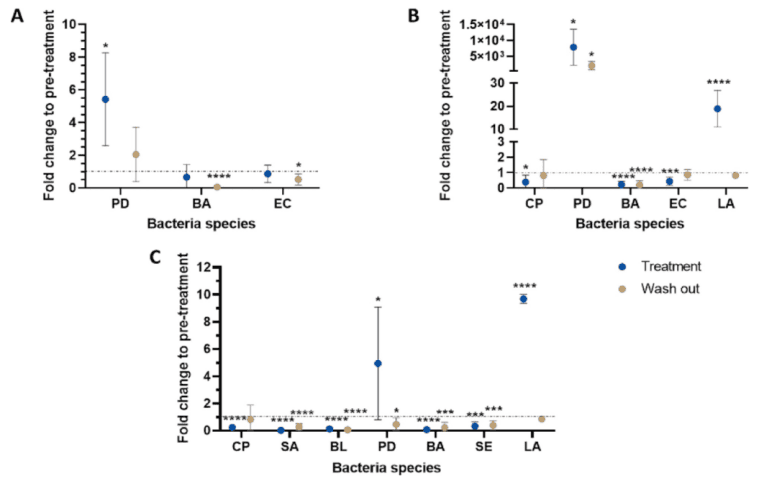
Figure 1: Fold changes in intestinal bacteria in (A) ascending colon, (B) transverse colon, and (C) descending colon following 2′-FL administration
2. 2'-FL promotes the production of beneficial intestinal metabolites
The 2'-FL intervention significantly influenced free fatty acids (FFAs), the primary metabolites of gut microbiota. LC/MS analysis revealed marked variations in nine FFAs across colon regions. In the ascending colon, all FFAs except hexanoic acid showed significant elevation. The transverse colon exhibited reduced hexanoic acid levels with increased concentrations of other FFAs, while seven FFAs demonstrated marked elevation in the descending colon. These findings indicate that 2'-FL optimizes the gut metabolic environment by enhancing beneficial short-chain fatty acids, strengthening intestinal barrier function, and demonstrating anti-inflammatory effects.
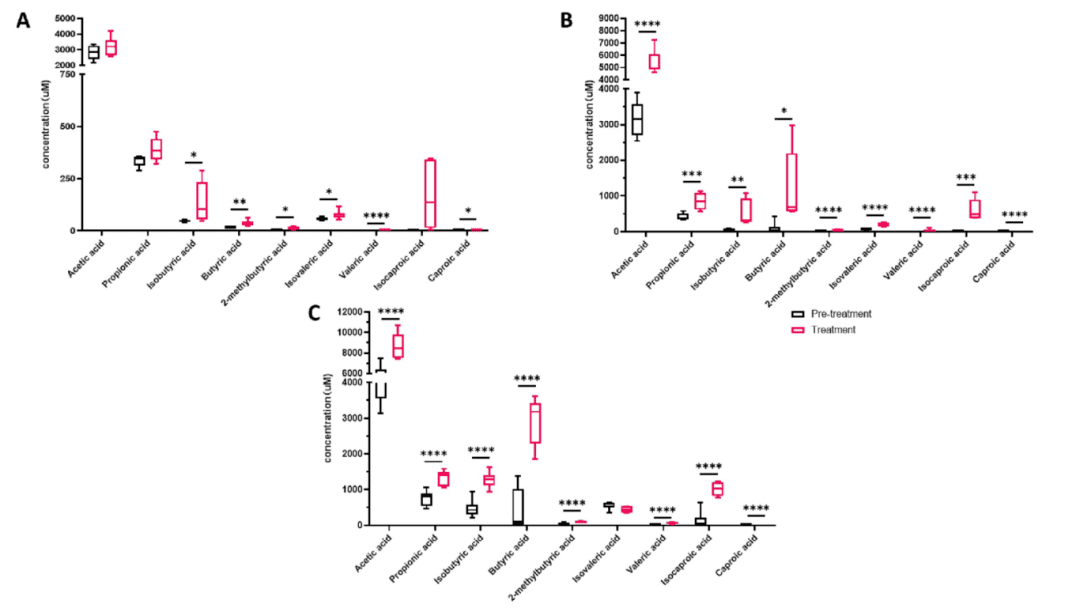
Figure 2: Schematic diagram of free fatty acid regulatory boxes in ascending colon (A), transverse colon (B), and descending colon (C) before and after 2′-FL addition
3. 2'-FL regulates the balance between gut microbiota and metabolites
Spearman correlation analysis revealed that 2'-FL indirectly regulates intestinal microbial diversity, thereby modulating fatty acid production. In the ascending colon, Staphylococcus epidermidis showed negative correlations with propionic acid and Clostridium perfringens with valeric acid. The transverse colon exhibited positive correlations between Lactobacillus acidophilus and most free fatty acids (FFAs), while the descending colon demonstrated significant positive correlations between Lactobacillus acidophilus and FFAs, and negative correlations between Bifidobacterium adolescentis and most FFAs (excluding caproic and isovaleric acids). Notably, harmful bacteria like Clostridium perfringens showed significant negative correlations with key FFAs such as acetic acid. These findings suggest that 2'-FL supports gut health by optimizing the balance between microbial communities and metabolic processes.
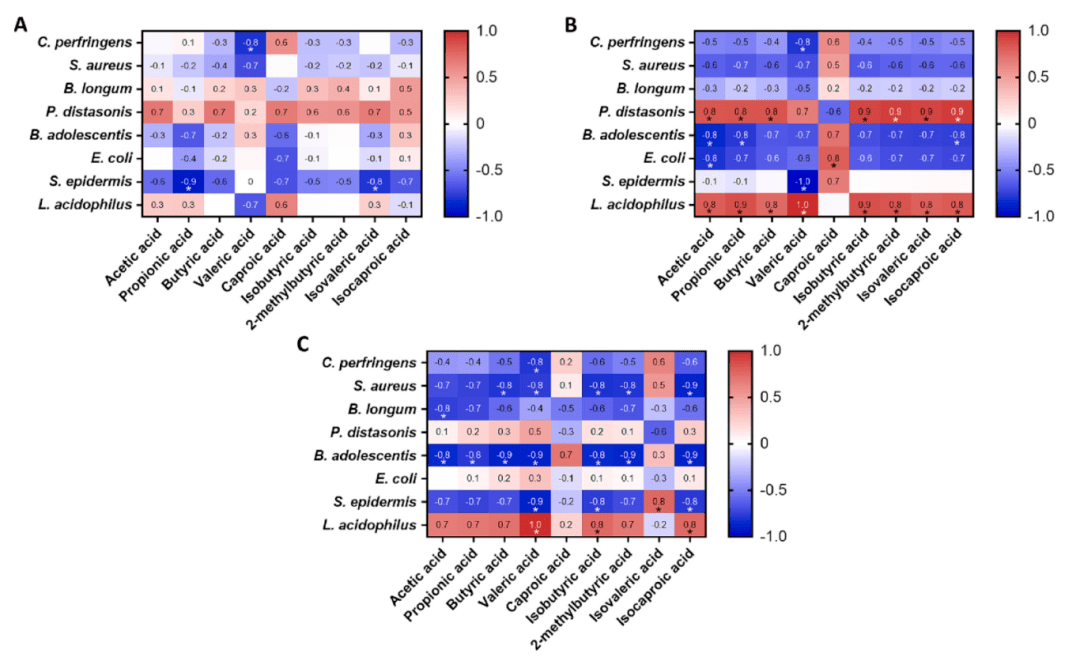
Figure 3: Correlation analysis of eight microbial species with nine free fatty acids in the ascending colon (A), transverse colon (B), and descending colon (C)
Discussion and outlook
This study utilized an in vitro human colon model (HCM) system to comprehensively reveal the crucial role of 2'-FL in regulating infant gut microbiota abundance and metabolism. The findings demonstrated that 2'-FL significantly promotes beneficial bacterial growth, inhibits harmful bacterial proliferation, and optimizes the production of metabolites such as short-chain fatty acids, thereby improving gut microbiota composition and metabolic balance. These results further establish 2'-FLs pivotal role in supporting early infant gut health. Future research should focus on evaluating the long-term efficacy of 2'-FL in vivo environments, particularly its performance under different feeding patterns, while exploring the development of functional foods based on 2'-FL to provide innovative solutions for infant gut health management.
References
[1] Zhang S, Chen L, Hu M, et al. 2-Fucosyllactose (2'-FL) changes infants gut microbiota composition and their metabolism in a host-free human colonic model[J]. Food Research International, 2023, 173: 113293.