background
Ulcerative colitis (UC) is a gastrointestinal disorder characterized by chronic inflammation of the colon mucosa, often presenting with bloody diarrhea. Research indicates that UC patients exhibit significant dysbiosis in their gut microbiota: a reduction in beneficial bacteria like Bifidobacteria and an increase in harmful bacteria such as sulfate-reducing bacteria. This imbalance not only exacerbates inflammatory responses but also further weakens the bodys immune regulation. Human milk oligosaccharides (HMO), particularly 2′-fucosyllactose (2′-FL), act as natural prebiotics that selectively promote the growth of beneficial bacteria. By generating short-chain fatty acids (SCFAs), 2′-FL helps reduce inflammation and regulate immune responses, thereby maintaining gut health. This study aims to investigate the role of 2′-FL in improving the composition and metabolic activity of the gut microbiota in UC patients.
Research design and methods
This study employed an in vitro fermentation model to simulate the intestinal environment of ulcerative colitis (UC) patients and evaluate the regulatory effects of 2′-FL on gut microbiota. The experiment collected fecal samples from three healthy controls and three UC patients, with four fermentation containers set up: one negative control group and three treatment groups supplemented with 2′-FL, fructooligosaccharides (FOS), and galactooligosaccharides (GOS). All samples underwent fermentation within 48 hours to simulate the anaerobic environment of the distal colon. Bacterial population changes were analyzed using fluorescence in situ hybridization (FISH) combined with flow cytometry, while short-chain fatty acid (SCFAs) production was quantified via gas chromatography-mass spectrometry (GC-MS). The study comprehensively assessed the effects of 2′-FL from both microbial community and metabolite perspectives.
Key findings
1. 2′-FL optimizes the gut microbiota structure in UC patients
Research indicates that UC patients exhibit significantly lower total bacterial counts and Lactobacillus abundance at baseline compared to healthy controls, indicating microbial dysbiosis. The 2′-FL intervention significantly increased beneficial bacteria such as Bifidobacterium and Lactobacillus while reducing harmful bacteria like Desulfotrichum. Compared to other substrates (FOS and GOS), 2′-FL demonstrates superior efficacy in suppressing harmful bacterial proliferation and restoring microbial balance.
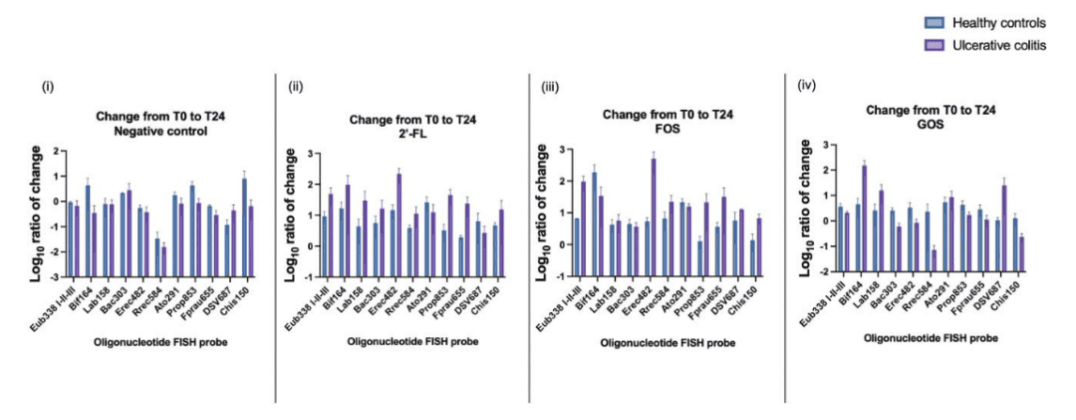
Figure 1: The ratio of baseline microbial community changes in the control group and UC patients, measured using each oligonucleotide probe for negative controls and each substrate after 24 hours.
2. 2′-FL promotes the production of beneficial intestinal metabolites in UC patients
In vitro fermentation demonstrated that 2′-FL significantly boosted short-chain fatty acids (SCFAs), particularly acetic acid, with concentrations rising dramatically from 0.952 to 49.9 mmol/L within 48 hours. Compared to other prebiotics, 2′-FL showed superior efficacy in elevating SCFAs such as acetic, propionic, and butyric acids. These fatty acids not only enhance intestinal barrier function but also play crucial roles in suppressing inflammation and regulating metabolism.
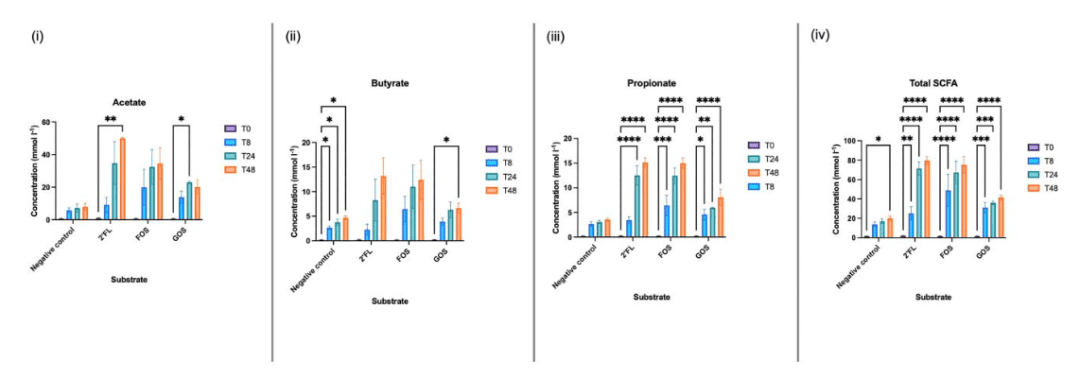
Figure 2: Organic acid concentrations of each substrate in negative control and UC patient samples at baseline and post-inoculation at 8, 24, and 48 hours; acetyl esters (i), butyrate esters (ii), propionate esters (iii), and total SCFA (iv)
Discussion and outlook
This study demonstrates that 2 -fucosyl lactose (2′-FL) effectively alleviates ulcerative colitis (UC). By promoting the growth of beneficial bacteria (e.g., Bifidobacterium and Lactobacillus) while inhibiting harmful bacteria (e.g., Desulfotrichum) proliferation, 2′-FL significantly improves gut microbiota imbalance in UC patients. Additionally, 2′-FL markedly increases the production of short-chain fatty acids (SCFAs), particularly acetic acid, thereby enhancing intestinal barrier function and reducing inflammatory responses. These findings further establish 2′-FLs potential as a functional prebiotic in UC adjuvant therapy. Future research should investigate the safety and efficacy of long-term 2′-FL administration in vivo, and promote its practical application in prebiotic food development.
References
[1] Kennedy J M , Aminda D S , Walton G E ,[1] Kennedy J M , Aminda D S , Walton G E , et al.Comparison of Prebiotic Candidates in Ulcerative Colitis using an in vitro Fermentation Model[J].Journal of Applied Microbiology, 2024.DOI:10.1093.